Dancing Road Color Balls Match
- 4.6
- Rating
- 100.00M
- Installs
- Free
- Price

 Analysis by App-foxy
I found Dancing Road Color Balls Match easy to understand within seconds and surprisingly demanding once the speed rises. It is a free arcade game from AMANOTES PTE. LTD. built around timing, color recognition, and music. You guide a ball along a moving path, collect matching colors, and try to stay synchronized with the rhythm instead of simply reacting to whatever appears next.
That simple idea is the reason it works so well for short sessions. I can open it when I have only a few minutes, understand the immediate goal without reading instructions, and start playing almost at once. At the same time, the game has enough pressure to make a failed run feel like something I want to improve rather than an experience I casually forget.
How the first few runs establish the goal
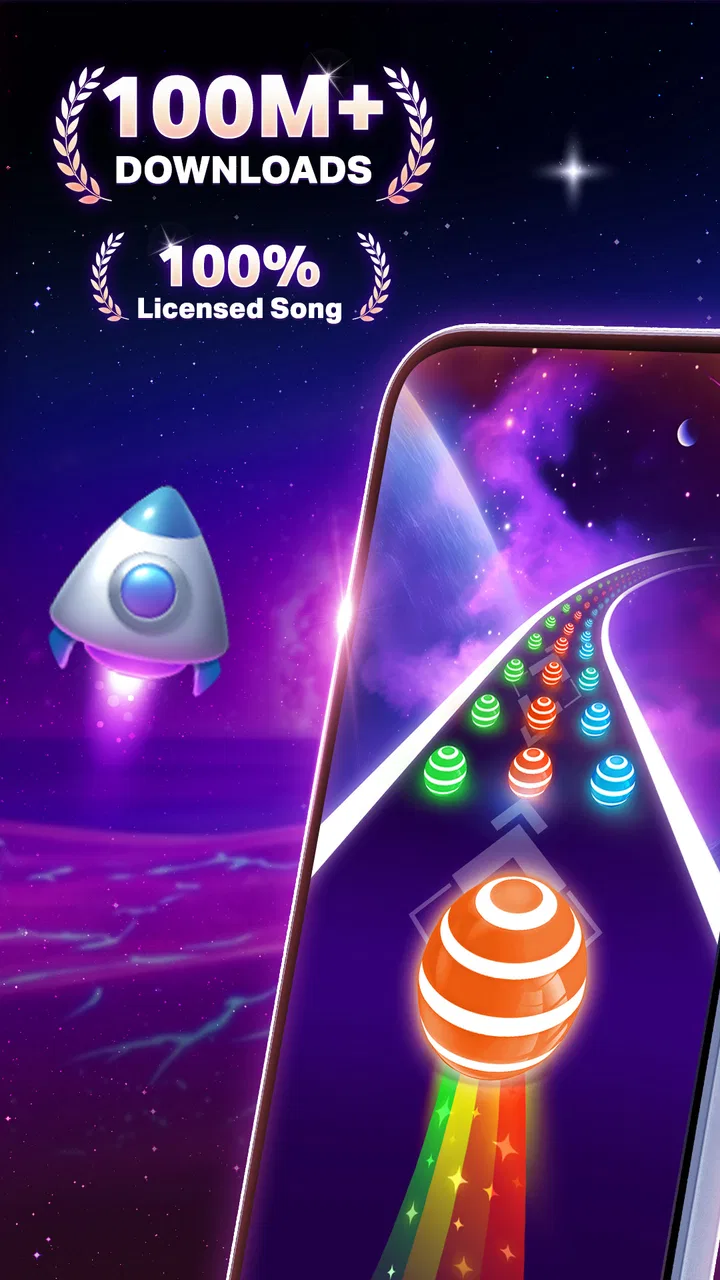
The opening experience is deliberately direct. The ball moves forward, the track rolls toward me, and my job is to guide it into the correct colored pieces. The important distinction is that this is not just a lane-switching game. I have to watch the color relationship and the approaching path together, while also keeping a sense of the beat.
You May Also Like

 Blood Strike: 2.5 Anniversary
Blood Strike’s Loadouts Turn Every Drop Into a Tactical Gamble
A close look at Blood Strike’s custom loadouts: how fast access to signature weapons reshapes its battle royale rhythm, rewards preparation, and narrows the gap between fights.

 Pandora - Music & Podcasts
Pandora’s Music Is Easy to Start, but Harder to Recover
Pandora’s strength is its low-effort path from a seed to a station. Its weak spot is how much confidence it asks you to place in connection, setup, and quiet recovery.

 8 Ball Pool
 Is Built on Rivalries, Rematches, and Routine
A close look at the rivalries, rematches, shared routines, and unanswered safety questions that turn a quick pool match into a persistent mobile community.

 Samsung Music
’s Quiet Strength Is Playing What You Already Own
Its reach comes less from spectacle than from dependable access to a personal library. That simplicity is both the app’s strongest retention engine and its ceiling.

 AccuWeather: Weather Radar
AccuWeather Review: A Quick, Clear Forecast for Everyday Decisions
For everyday plans, the best forecast is the one you can understand quickly. AccuWeather makes rain timing, radar, and local conditions easy to act on, with a few trade-offs.

 Hill Climb Racing
Why Hill Climb Racing Still Turns Crashes Into One More Run
A tiny car, a bumpy hill and one more upgrade: Hill Climb Racing keeps resurfacing because its simple chaos makes every near-miss feel personal.
More From Our News Desk



That creates a useful early goal: survive long enough to understand the rhythm, then replay the same kind of challenge with better control. The game does not need a complicated mission structure to give me direction. Each run asks a clear question: can I keep my attention steady when the route becomes faster and less forgiving?
The color matching is especially accessible for younger players and anyone who prefers games with rules that can be learned visually. The content rating is Everyone, and the presentation avoids the kind of complicated setup that can discourage a new player. I would still recommend that parents consider whether quick-reaction play suits a particular child, but the basic concept is friendly and immediately readable.
One detail that matters more than it first appears is the difference between looking at the ball and looking ahead of it. New players often wait until a colored piece is almost underneath them before deciding. I found better results by scanning the next section of the track early, then making smaller movements instead of one large correction. That habit turns the game from frantic swiping into a more controlled rhythm exercise.
The music also gives the first sessions their identity. It is not merely background decoration. The beat helps me anticipate movement, although I do not rely on sound alone. In a noisy room, or when I am playing without concentrating on the audio, the color and position cues remain essential. This makes it approachable for casual play while still rewarding players who become comfortable using both visual and musical timing.
What makes progress feel noticeable
The strongest progress signal is personal improvement. I notice it when a section that previously caused an immediate mistake becomes manageable, or when I can stay calm through a sequence that once made me overcorrect. This is a good fit for players who enjoy repeating a short challenge and refining their technique instead of needing a large story or a long list of objectives.
The game has earned a 4.6 average from around 772 thousand ratings, and its reach is reflected in more than 100 million installs. Those figures do not guarantee that everyone will enjoy it, but they match my impression that the central loop is broadly understandable. It offers a familiar arcade structure while adding enough rhythm and color awareness to distinguish it from a basic endless runner.
I would describe the progress as skill-based rather than deeply character-driven. The satisfaction comes from better timing, cleaner movement, and learning how the track presents its next demand. If you expect a role-playing system with equipment, a narrative campaign, or a detailed avatar-building path, this is not the kind of progression you will find satisfying. Its reward is the run itself and the feeling that your hands and eyes are becoming more reliable.
That distinction is important when deciding whether to install it. I can recommend it to someone who likes compact arcade sessions and enjoys chasing a better performance. I would be more cautious with a player who needs constant unlocks, a large collection of content, or a strong reason to return beyond personal mastery.
For a practical routine, I found it works well as a short reset between tasks. After finishing an email or waiting for public transport, I can play one or two attempts without committing to a long session. The immediate restart structure suits that situation. However, the same convenience can make it easy to keep trying after the game has stopped feeling relaxing, especially when a difficult section seems almost within reach.
Difficulty rises through attention, not complexity
The difficulty curve is based less on adding complicated rules and more on demanding faster, more accurate decisions. At first, I have enough time to identify the next color and position the ball. Later, the same basic action requires earlier recognition and more confidence. A small hesitation can become a missed match, and a hurried correction can send the ball toward the wrong color.
This is where the rhythm design becomes a real strength. The music encourages a steady pace, but the player still needs to interpret the track. I cannot simply tap automatically to every beat and expect consistent results. Visual changes and route positioning remain important, so the game tests coordination rather than musical memory alone.
My most useful adjustment was to stop treating every movement as an emergency. When I reacted too dramatically, I often created a second mistake while trying to fix the first. Short, deliberate swipes gave me more control. I also learned to keep my attention near the next decision point rather than staring at the ball itself. That is a small technique, but it makes the later sections feel less chaotic.
The trade-off is that the game can become tense rather than relaxing. Someone looking for a gentle music game may enjoy the early flow but dislike the pressure once mistakes arrive quickly. In contrast, players who like arcade repetition will probably see the increasing demand as the main attraction. The game does not need elaborate enemy behavior or puzzle rules to create challenge; timing alone does most of the work.
Device comfort can affect the experience too. Because the game depends on quick visual reading and accurate input, a cramped screen, distracting notifications, or an awkward grip may make play feel harder than it should. I prefer holding the phone securely with one hand while using the other for controlled input, though the best setup depends on the device and the player. Playing with full attention is much more effective than trying to divide it between the game and another task.
The current version is 3.0.3 and supports devices running Android 7.0 or later. That makes it available to many Android users, including people who are not using a recent phone. Still, compatibility is not the same as comfort. Older hardware may provide a less pleasant experience if movement feels less responsive, so I would judge the game by how accurately the ball reacts on the particular device rather than by the operating-system requirement alone.
Where the replay pressure helps and where it becomes tiring
The retention pressure comes naturally from the structure of a run. When I fail, the reason is usually understandable: I missed a color, moved too late, or lost the rhythm. That clarity encourages another attempt because improvement feels possible. I am not replaying simply because the game tells me to; I am replaying because I can identify a mistake and try to remove it.
That is a healthier kind of motivation than a system that constantly interrupts play with chores. The short format also lowers the cost of failure. A bad attempt does not consume a large block of time, so restarting feels reasonable. This matters in an arcade game, where the difference between an irritating defeat and a motivating defeat often comes down to how quickly I can return to the action.
There is a limit, though. Repetition can feel narrow if I am not personally interested in improving timing. The core loop stays focused on matching colors and following the rolling route, so it does not transform into a different genre after several sessions. A player who needs fresh mechanics every few minutes may find the experience predictable, while someone who enjoys polishing a skill may appreciate that consistency.
In-app purchases range from $0.99 to $69.99 per item. Since the game is free to download, I would approach spending carefully and decide in advance whether optional purchases add enough value for my own play style. The important point is not to confuse a free entry price with an unlimited obligation to spend. I can test the core arcade loop first and decide whether it deserves further investment.
I also think the purchase range makes the game better suited to players who are comfortable ignoring optional spending when it does not improve their enjoyment. If you prefer a completely fixed-price experience with no purchase decisions, a paid arcade alternative may feel more straightforward. On the other hand, someone who wants to try a rhythm-based color game without paying at the start has little risk in beginning here.
The game’s strongest retention tool is still the feeling of mastery, not the promise of a large world. That makes its audience fairly clear. It is good for a person who likes “one more try” sessions and can stop when the challenge stops being fun. It is less suitable for anyone who finds repeated failure stressful or who wants a calm, uninterrupted soundtrack experience.
How it compares with familiar arcade alternatives
Compared with a standard endless runner, this game places more weight on color recognition and musical timing. An endless runner may ask me to avoid obstacles, jump, or change lanes based mainly on distance and reaction speed. Here, choosing the correct color is central, so I am reading the route in a different way. The result feels more like a coordination exercise than a simple race for distance.
Compared with a traditional rhythm game, it is more visually active and less dependent on tapping exact notes in a fixed interface. I am guiding a moving ball through space, which gives the experience a stronger sense of motion. The compromise is that players seeking precise note charts, deep song selection, or a dedicated music-game structure may find this approach comparatively light.
It also differs from puzzle games that let me pause and think through a board. The route keeps moving, so decisions have to be made in real time. That makes it better for quick reflex practice and less appropriate for someone who wants a slow, analytical challenge. I would choose a conventional puzzle game when I want to plan several moves ahead; I would choose this one when I want my attention and hands occupied immediately.
Another practical comparison is with idle or collection-focused arcade games. Those often provide progress through upgrades or accumulating items over time. This title is more dependent on what I can do during the run. If I put it down for a week, I do not expect a passive system to carry me forward. Returning means rebuilding my timing, which can be either refreshing or inconvenient depending on what I want from a mobile game.
That focused design is why I would not call it a universal arcade recommendation. It has a clear identity, but it does not try to cover every kind of casual player. Its best audience is someone who enjoys music-backed movement, quick restarts, and visible improvement through practice.
Who should play it and who should look elsewhere
I would recommend it to commuters, casual arcade fans, and players who enjoy games that communicate their rules through color and motion. It is also a reasonable choice for someone who wants a free starting point before deciding whether rhythm-based arcade play is appealing. The Everyone rating and straightforward control scheme make the first step easy, while the later timing demands give experienced players something to work on.
I would skip it if I want a substantial story, a calm experience with no pressure, or a progression system built around collecting and customization. I would also look elsewhere if I dislike replaying similar sections after failure. The game’s appeal depends on accepting repetition as practice. Without that mindset, the same design can feel restrictive rather than focused.
For the best first session, I suggest playing with notifications silenced, sound available if possible, and a few uninterrupted minutes to learn the movement. Do not judge the game by the first mistake. Instead, notice whether the feedback helps you understand what went wrong. If the answer is yes, the gradual increase in speed may keep you interested. If every failed run feels arbitrary, the rhythm-and-color format is probably not matching your preferences.
It is worth remembering that the developer is AMANOTES PTE. LTD., and the game sits firmly in the arcade category rather than presenting itself as a full music-production or puzzle experience. That expectation keeps the review fair. I enjoy it for the immediacy of its loop, not because it offers the breadth of a larger premium game.
My verdict on its pacing and long-term appeal
After spending time with it, I think the pacing succeeds because it starts with a goal anyone can understand and then makes precision increasingly important. The early runs teach the relationship between movement, color, and beat. Later attempts test whether I can apply that understanding without panicking. Progress is signaled through my own improved control, while replay pressure comes from short failures that feel recoverable.
The design is at its best when I treat each attempt as a small practice session. I can focus on looking ahead, making smaller corrections, and using the music as a guide rather than depending on it completely. Those habits give the game more depth than its short description suggests, even though the underlying rule remains simple.
My final recommendation is positive but specific: choose it if you want a free, fast-moving arcade game that combines color matching with rhythm and rewards repetition. Keep your expectations modest about broader progression, and be mindful of optional in-app purchases priced from $0.99 to $69.99 per item. For me, the lasting value comes from improving a run, not from collecting a large amount of content.
The progression verdict is clear: Dancing Road Color Balls Match sustains play through readable goals, rising timing pressure, and the satisfaction of turning a failed sequence into a successful one. It is not the right game for every mobile player, but when I want a focused two-minute challenge that can become surprisingly demanding, it earns a place on my phone.
FAQs for Dancing Road Color Balls Match
01What is Dancing Road: Color Balls Match?
Dancing Road: Color Balls Match is a rhythm-based music game where players guide a colored ball down a winding road, matching the ball's color with the road's segments. The game combines vibrant graphics with a dynamic music soundtrack, offering an engaging and immersive experience for music lovers and casual gamers alike.
02How do you play Dancing Road: Color Balls Match?
To play Dancing Road, you must swipe left or right to match your ball's color with the approaching road segments. As the game progresses, the speed increases, and the music becomes more intense, requiring quick reflexes and precise timing. It's a test of both rhythm and coordination.
03Is Dancing Road free to download and play?
Yes, Dancing Road: Color Balls Match is free to download on both Android and iOS platforms. However, the game includes in-app purchases, which allow players to buy additional features or remove ads for an uninterrupted gaming experience. Be mindful of these options if you're trying to play cost-effectively.
04Does Dancing Road require an internet connection?
Dancing Road can be played offline, making it ideal for users who want to enjoy the game without a constant internet connection. However, some features, such as downloading new songs or accessing certain in-app purchases, may require internet access.
05What are the key features of Dancing Road: Color Balls Match?
Key features of Dancing Road include its vibrant, colorful graphics, a variety of music tracks spanning different genres, and challenging gameplay that increases in difficulty. The game offers a seamless blend of visual and auditory elements, providing users with an engaging and dynamic music gaming experience.
Pros
- Engaging music tracks enhance gameplay.
- Vibrant graphics create a lively experience.
- Simple controls suitable for all ages.
- Regular updates with new challenges.
- Offline play available for uninterrupted fun.
Cons
- In-app purchases can be pricey.
- Ads may disrupt gaming experience.
- Occasional lag on older devices.
- Limited customization options.
- Repetitive levels might bore some players.

Dancing Road Color Balls Match
Gallery